
ISO 20022 messages are easy to describe and hard to read. A single payment instruction can hold hundreds of elements, nested several levels deep, each with a type, a cardinality, and rules that tie it to the others. The official documentation is complete, but it was never meant to be skimmed.
Today we are releasing the ISO 20022 Message Explorer, a free way to look inside a message, build one, and know whether it is valid, all in your browser:
iso20022-explorer.beneficialstrategies.com
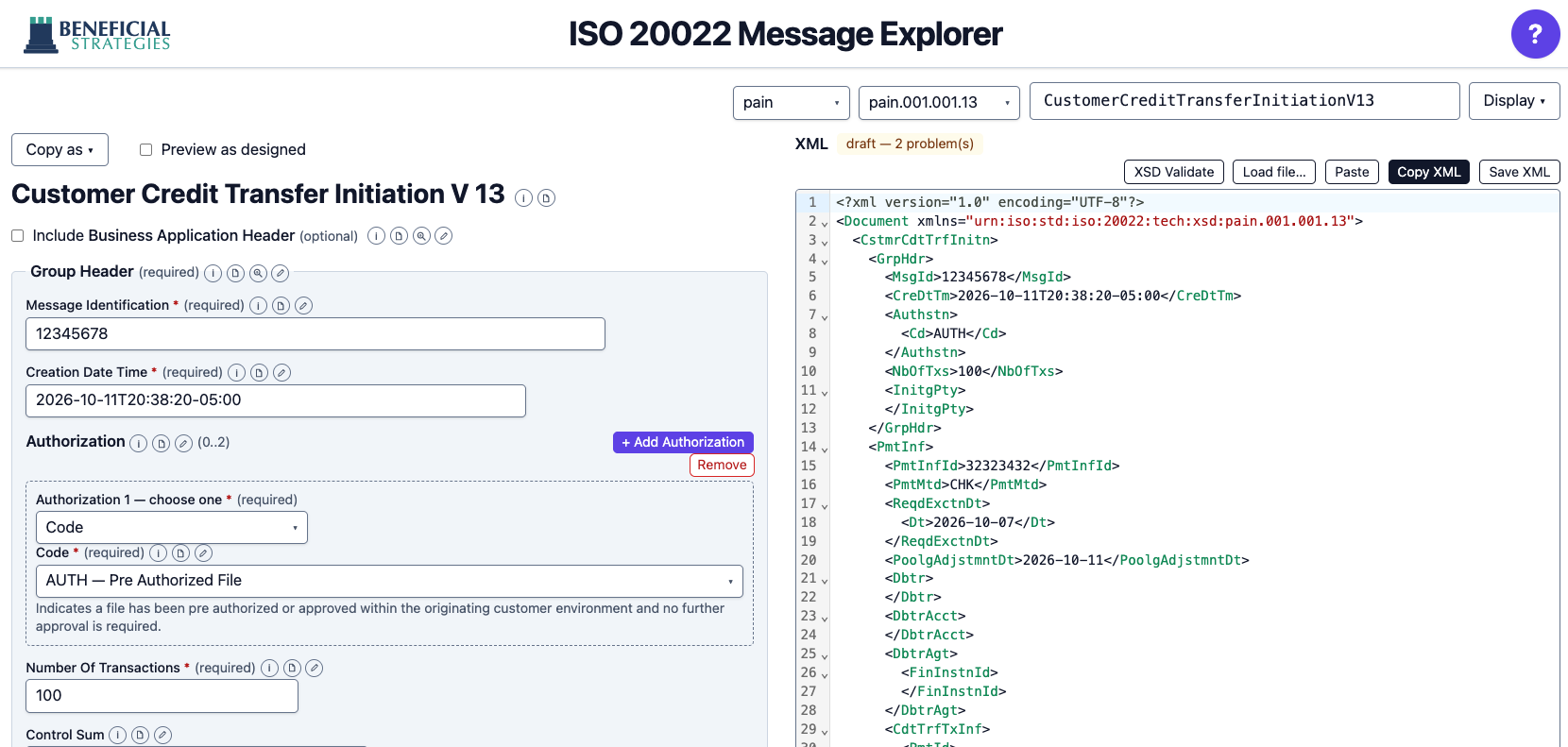
The form is on the left, and the message it produces appears beside it as XML as you type.
What you can do with it
- Explore the format and the content. Pick a business area and a message and see every element it can hold: its name, its meaning in the official ISO 20022 definition, the values it allows, and the business rules that connect fields. Hover the i next to any label for its definition.
- Create a new message. Fill in the form to build a message from scratch. Your entries are checked as you type, and the finished message appears beside the form as XML or ISO 20022 JSON.
- Save it and come back later. Save what you have to a file and load it again, or paste a message you already have to see it laid out as a form. Everything stays in your browser.
- Take illustrations for your analysis documents. Zoom into the part of a message you want to discuss, then take a screenshot or use Copy as to put it into Word, a spreadsheet, Markdown, or Figma.
- Reuse the controls in your own application. The Implement! button gives step-by-step instructions for adding the same controls to your own app, with the install commands for the React, Vue, Svelte, or plain TypeScript packages.
The first time you visit, a short guided tour points out each part of the screen. You can start it again from the ? button, and send it to a colleague with the new Share button.
What is included in this release
This is a first release, and it covers a subset of the standard. The Explorer supports more than 300 message definitions across 12 business areas:
| Area | What it covers |
|---|---|
pain |
payments initiation |
pacs |
payments clearing and settlement |
camt |
cash management |
acmt |
account management |
admi |
administration |
caam |
ATM management |
remt |
payments remittance advice |
trck |
payments tracking |
seev |
securities events |
semt |
securities management |
sese |
securities settlement |
head |
the business application header |
That is 12 of the 36 business areas in the standard. Areas such as cards, foreign exchange, and trade services are not in this release, and a few individual messages inside the covered areas are left out on purpose, where the standard’s own published data does not yet define them completely.
We would rather release a part that works well than a whole that does not. If an area you need is missing, tell us which one. It will help decide what we add next.
Where the content comes from
Definitions and code lists come straight from the official ISO 20022 repository, so what you see is the standard’s own text, not a paraphrase. The Explorer is available in English, and in Spanish text that is machine-translated and not yet reviewed. Corrections to the Spanish are welcome.
Built on open-source packages
The Explorer runs on the same open-source @beneficial-strategies packages that anyone can install
from npm, which is how it can show you exactly what to add to your own application. They are
published as alpha (pre-release) versions, so expect them to change while we finish the first
production release. The source is on
GitHub.
Try it, and tell us what you think
Open the Explorer, pick a message you work with, and see how it looks. If something is confusing, wrong, or missing, we want to know.